Yeonsu Jung

Interactive portfolio · 3D imaging

Yeonsu Jung

Research Associate · Applied Mathematics, Harvard SEAS · Mahadevan group

X-ray micro-CT of things whose structure hides inside them: a nest, a gripper of tangled filaments, a rod packing, a granular silo and a model brain. Then the image processing that turns a scan into something to measure and simulate.

Each panel is live, not a video. It starts when you scroll to it; click it to rotate a scan, slice through it, or watch the rods in a packing being found one by one.

01 · Micro-CT

Five scans, in 3D

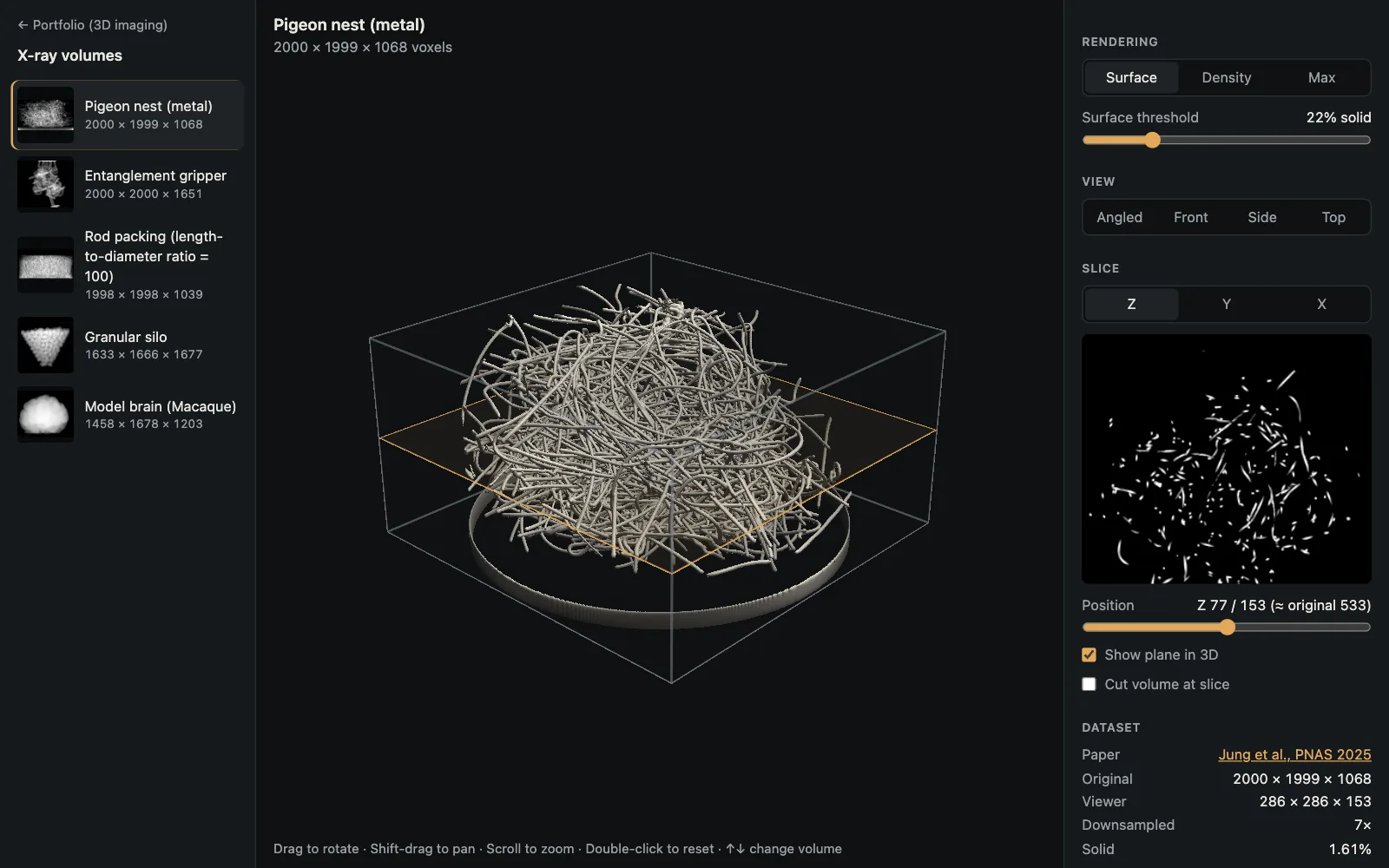
Each scan is a binarized tomogram, one to two thousand voxels on a side. For the browser it is cut into blocks 6 or 7 voxels on a side, and each block keeps the fraction of it that is solid, so a strand thinner than a block fades instead of disappearing. The volume is then ray-marched on the graphics card.

1.1

Five micro-CT scans
  • X-ray micro-CT
  • binarization
  • volume rendering

Pick a scan from the list. Drag to rotate it; the surface threshold sets how solid a block must be to be drawn, and Density and Max show the scan as a cloud instead. Under Slice, step through it along any axis, or cut it open at the slice to look inside.

Papers
Pigeon nest and rod packing: Y. Jung, T. Plumb-Reyes, H.-Y. G. Lin, L. Mahadevan. Entanglement transition in random rod packings.PNAS 122, e2401868122 (2025) · first author
Entanglement gripper: K. Becker, C. Teeple, N. Charles, Y. Jung, D. Baum, J. C. Weaver, L. Mahadevan, R. Wood. Active entanglement enables stochastic, topological grasping.PNAS 119, e2209819119 (2022)
Model brain: S. Yin, C. Liu, G. P. T. Choi, Y. Jung, K. Heuer, R. Toro, L. Mahadevan. Morphogenesis and morphometry of brain folding patterns across species.eLife 14, RP107138 (2025)
Granular silo: unpublished
Shown
5 scans, each about 300 blocks on a sidea scan is downloaded when it is picked: 0.6 to 3.4 MB

02 · Reconstruction

Finding every rod in an X-ray scan

To compare a real packing with a simulated one, the tomogram first has to become a list of rods. The pipeline matches cylinders to voxels: find a rod, trace it, remove its voxels, look for the next. Fitting one cylinder is a small optimization problem: it can be done by direct search or, more simply, by a trimmed principal-component fit, which is a singular value decomposition.

2.1

A whole scan, rod by rod

  • X-ray tomography
  • segmentation

Every rod the cylinder-matching pipeline found in one image stack: 4,582 rods in 2000 × 2000 × 741 voxels, from 4,664 traces made in 722 s, then cut at kinks and joined into whole rods. Press Play to watch them appear in the order they were found. Colour them by direction or length, cut a slab through the pack, or click a rod to read its numbers.

Paper
Y. Jung, T. Plumb-Reyes, H.-Y. G. Lin, L. Mahadevan. Entanglement transition in random rod packings.PNAS 122, e2401868122 (2025) · first author
Shown
4,582 rods at their measured radius, straightened to within one voxel of the traced centreline
2.2

How one rod is found

  • optimization
  • trimmed PCA (SVD)
  • direct search

A 201³-voxel crop from the dense centre of a packing, 442,435 rod voxels, segmented by four versions of the pipeline. Play runs two of them on the same clock, at their measured speeds.

Further down the page, one cylinder fit is taken step by step. A trimmed principal-component fit and a direct search (fminsearch) start from the same deliberately poor guess, 1.5 voxels off centre and 12° tilted, and each tries to fill the cylinder with voxels.

Paper
Y. Jung, T. Plumb-Reyes, H.-Y. G. Lin, L. Mahadevan. Entanglement transition in random rod packings.PNAS 122, e2401868122 (2025) · first author
Shown
One 201³ crop · four pipeline versions · one cylinder fit, two methods