Yeonsu Jung

Interactive portfolio · simulation and optimization

Yeonsu Jung

Research Associate · Applied Mathematics, Harvard SEAS · Mahadevan group

I simulate slender things in contact (whips, snakes, rod packings, filament grippers, printed lattices) and use optimization to make them do something on purpose, or to explain why they hold together.

Sections 1 to 4 are live. Each panel is a recorded simulation or reconstruction, not a video. It starts when you scroll to it; click it to orbit, scrub through time, switch runs, or put two side by side.

01 · Simulation first

Elastic rods in joint coordinates

A cable, a whip or a snake written as a chain of links on ball joints, so the rod shares its coordinates, and its engine, with the robot that holds it. The chain has to move like the rod it stands for before anything is optimized on top of it. These three are what the model is for: deformable linear objects with fast dynamics.

Paper · Y. Jung, “Geometrically exact Kirchhoff rods in joint coordinates: dynamic fidelity and control applications” (tentative title), in preparation.

1.1

Whip cracking

  • PDE-constrained optimization
  • differentiable simulation
  • periodic LQR

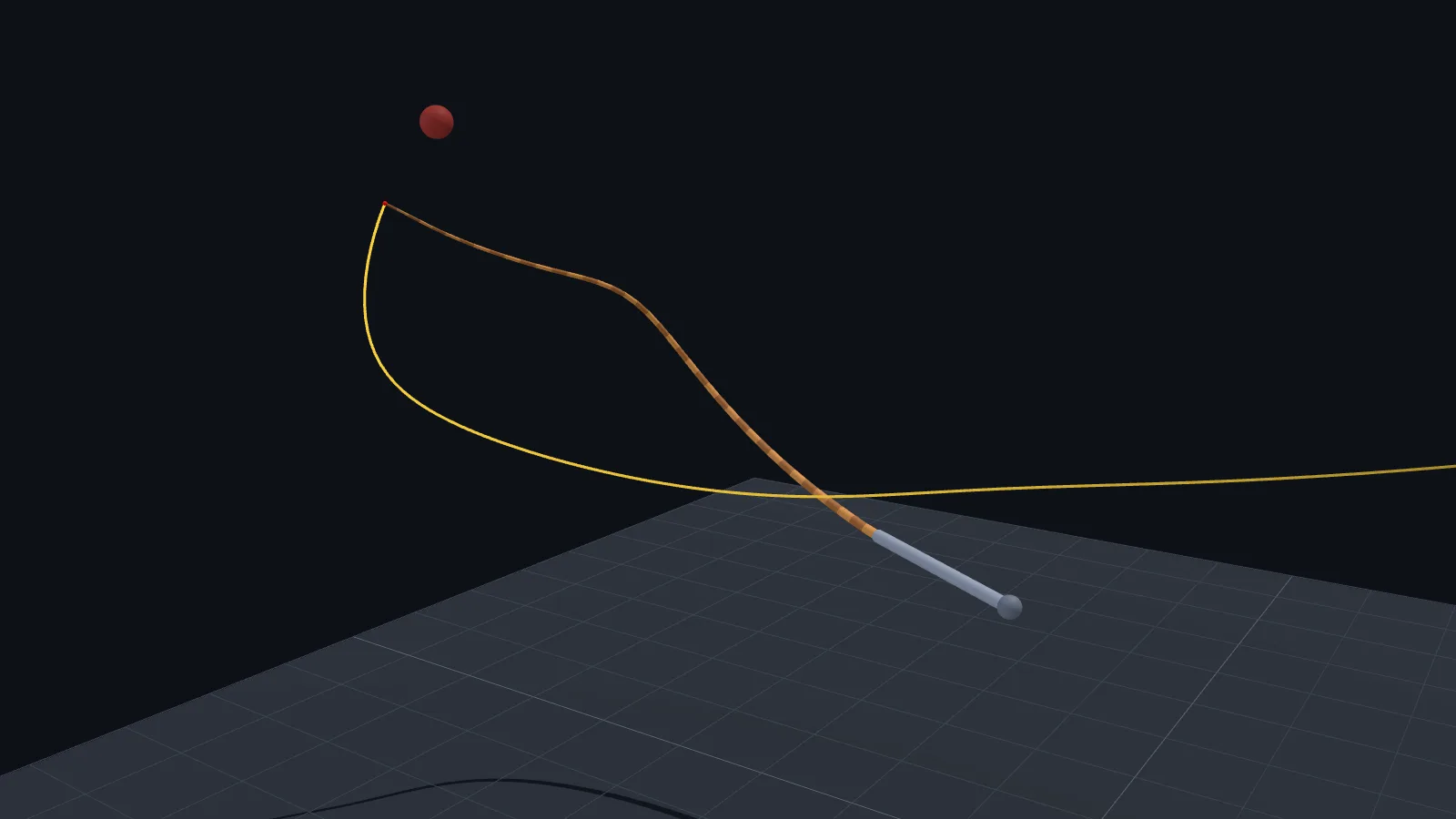
A 3 m tapered whip of 40 elastic links on a five-axis shoulder (three slides and two hinges), the only motors. A 0.25 s open-loop drive, found by differentiating through the simulation, sends a wave down the whip: the tip passes 5.8 mm from the target at 68 m/s, 6.8 times the hand's top speed.

The other runs put the same rig on a periodic orbit, one crack a second at 58 m/s. The orbit is unstable (a deviation grows 52-fold per period), so a periodic LQR on the shoulder motors holds it. Without feedback, rounding error alone grows the miss from 2.7 µm to 25.7 mm in eight periods.

Model
40 links · 3 m, tapered · five-axis shoulder
Found by
Gradient through the simulation (the crack); periodic LQR (the orbit)
Shown
4 runs: the crack at 1 ms steps, three orbits of 8 periodsthe target is drawn 70 mm in radius so it can be seen
1.2

Holonomy: the two-link cat flip

  • holonomy
  • PDE-constrained optimization
  • differentiable simulation

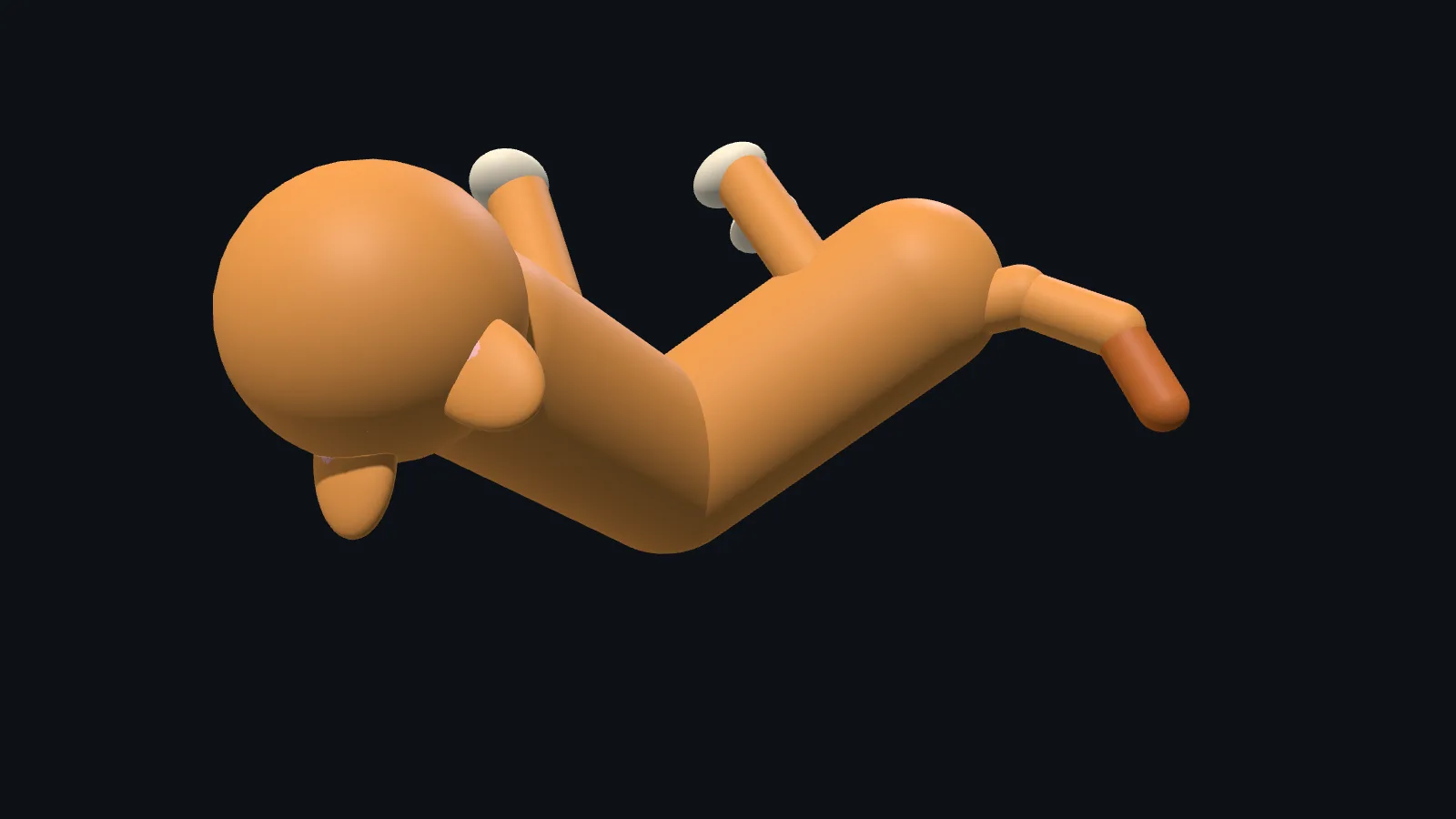
The falling-cat problem at its smallest: two links on one ball joint, floating with no angular momentum. The joint bends 90°, the plane of the bend is carried 273° around the body, and the joint straightens. The body comes out rolled 180° about its long axis although the joint never twists. The rotation is a holonomy: it comes from the loop the joint traces, not from any spin.

Executed by motors bounded at 12 N m, the same gait lands at 179.9°; four times faster the motors saturate and it overshoots to 192.9°. A smooth gait found by optimization comes within 2° of the half turn with torques that peak at 0.75 N m.

Model
Two links on one ball joint · 1 m · no gravity, no angular momentum
Found by
A three-phase bang-bang plan; an optimized smooth gait
Shown
4 runsthe cat is a drawing on two capsule links
1.3

Cobra rearing

  • reinforcement learning
  • PPO

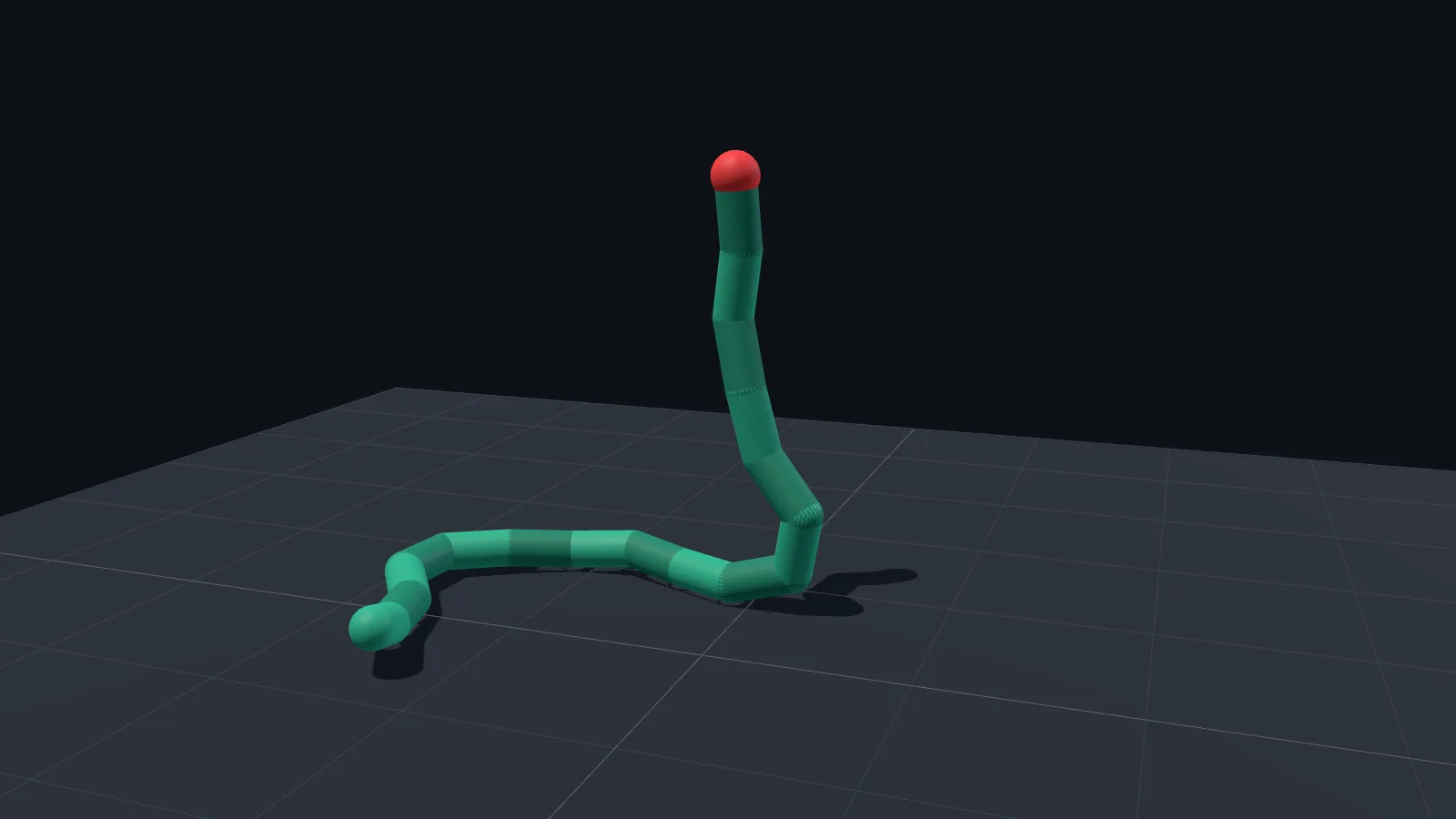
A chain of 16 links, 1.44 m long, lies on the floor, with a motor at each of its 15 ball joints and the rod's elastic law between the links. A policy trained by reinforcement learning (PPO, 400 iterations) rears the far end into a cobra pose and holds it: over the second half of the 18 s episode the head stays 0.56 m up, with 6 links off the floor.

Model
16 links · 1.44 m · 15 motorized ball joints
Found by
PPO, 400 iterations
Shown
One archived evaluation rollout: 599 policy steps, 30 ms apart

02 · Many bodies in contact

Many-body simulations: entangled rods and filaments

Many thin bodies can hold together, or hold an object, with no single strong contact. What matters is collective: how they wind around and cage one another. Three views of that: a packing as it entangles, a gripper that grasps by tangling, and entanglement made into the objective.

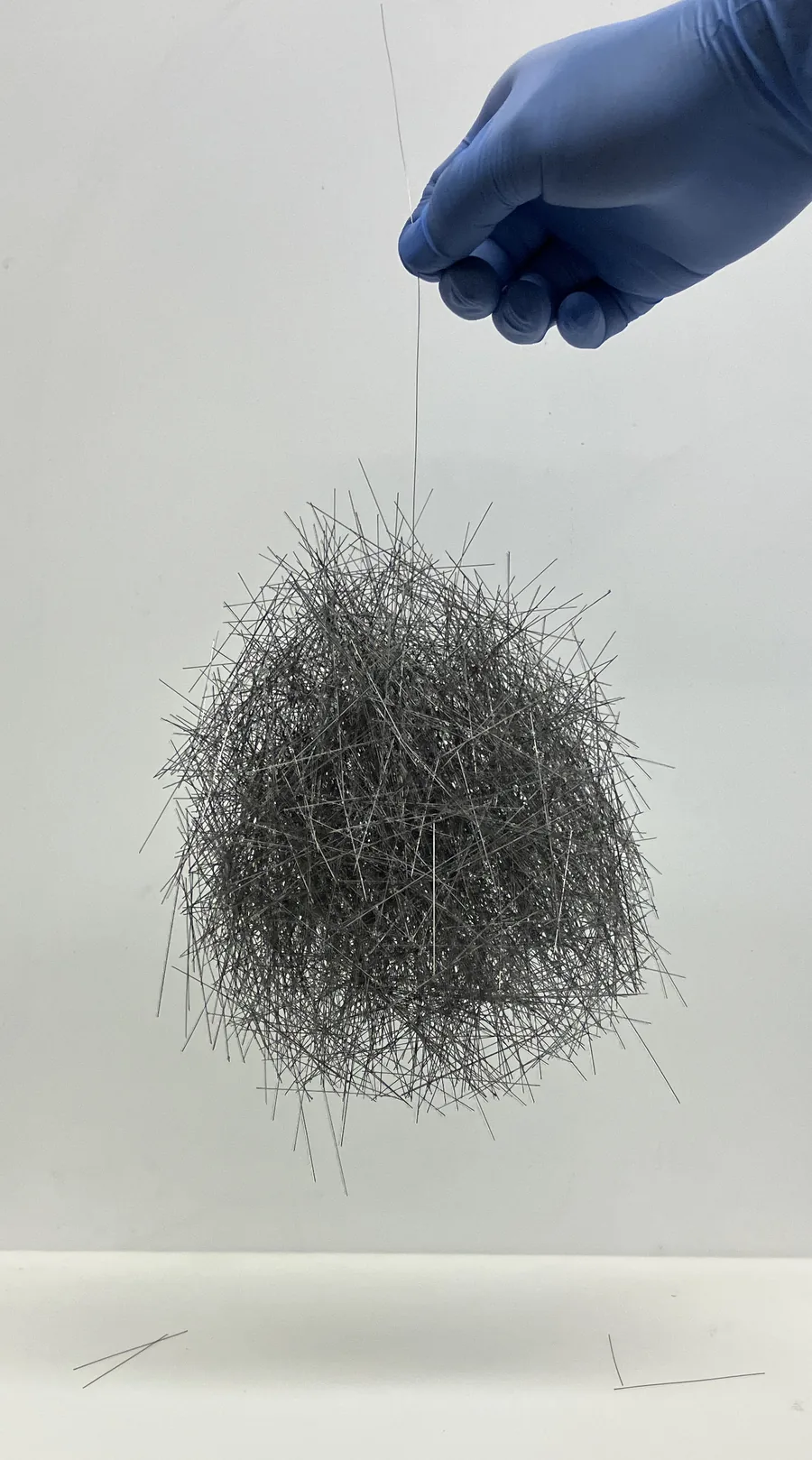
A ball of tangled thin rods hanging from a single rod held in a gloved hand.
In the laboratory. Rods are dropped through a mesh into a beaker; the mesh keeps them from arriving already tangled. The long ones, aspect ratio 200, come out together when a single rod is lifted. The shorter ones, aspect ratio 38, stay a pile. The movie is sped up. Right: such a tangle, hanging from one rod.
2.1

Rod packing dynamics

  • contact
  • entanglement

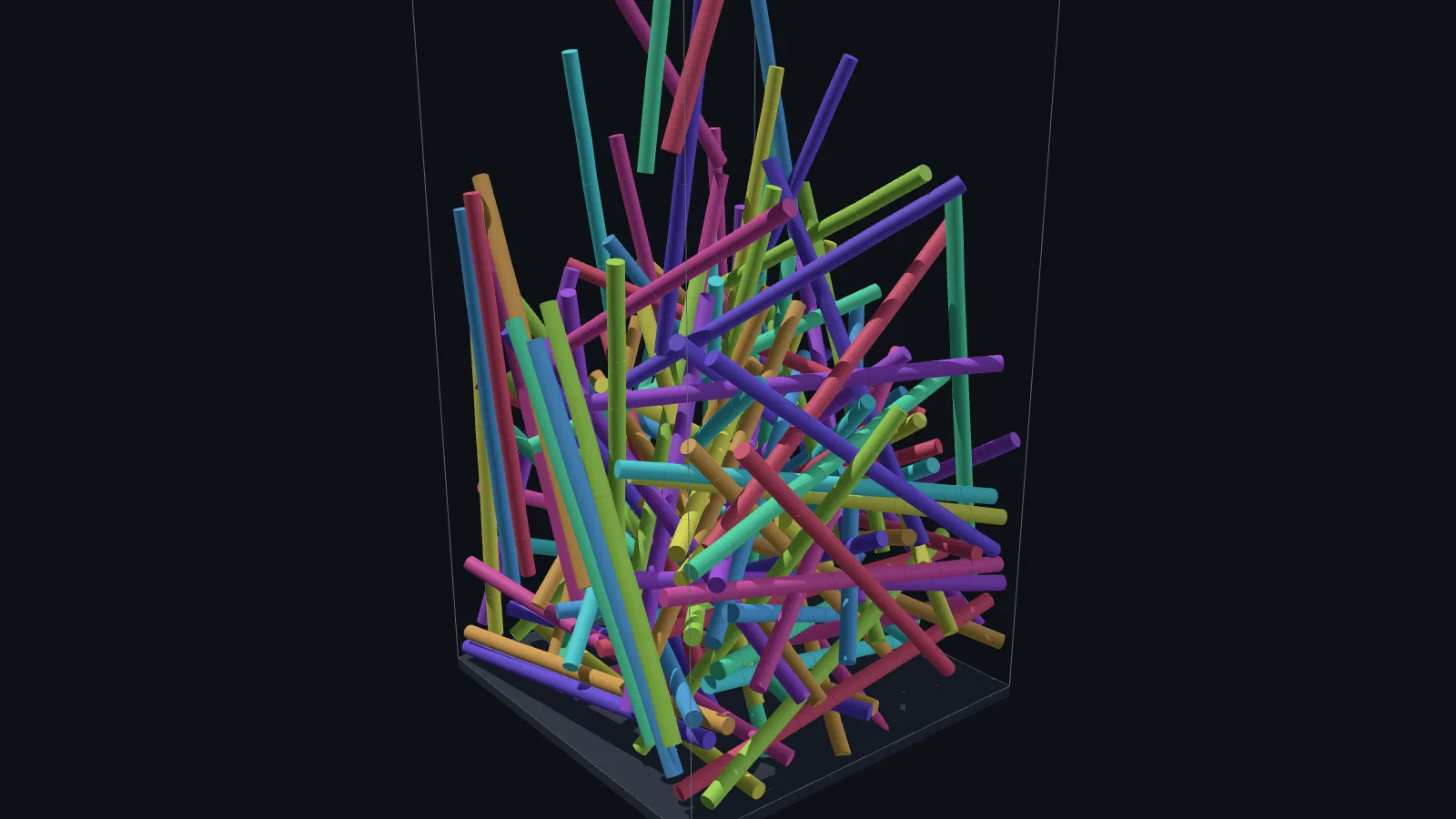
Rods entangling in a shaken box: 125 rods of aspect ratio 25, and 1,500 rods of aspect ratio 300, five seconds each. A second pair of runs is the vibration test, a pile of each kind on an open, vibrating floor: the short rods spread flat, the long ones stay a pile. Follow the contacts per rod, the largest cluster or the mean speed over time.

In the paper, X-ray tomography and simulation show that as rods get longer, regions of strong entanglement spread until they percolate through the packing, together with a sharp change in its mechanical stability.

Paper
Y. Jung, T. Plumb-Reyes, H.-Y. G. Lin, L. Mahadevan. Entanglement transition in random rod packings.PNAS 122, e2401868122 (2025) · first author
Shown
4 runs · 501 frames over 5 s each · 10 nodes per rodthe box is drawn from a fit to the logged motion
2.2

Grasping by tangling

  • stochastic grasping
  • contact

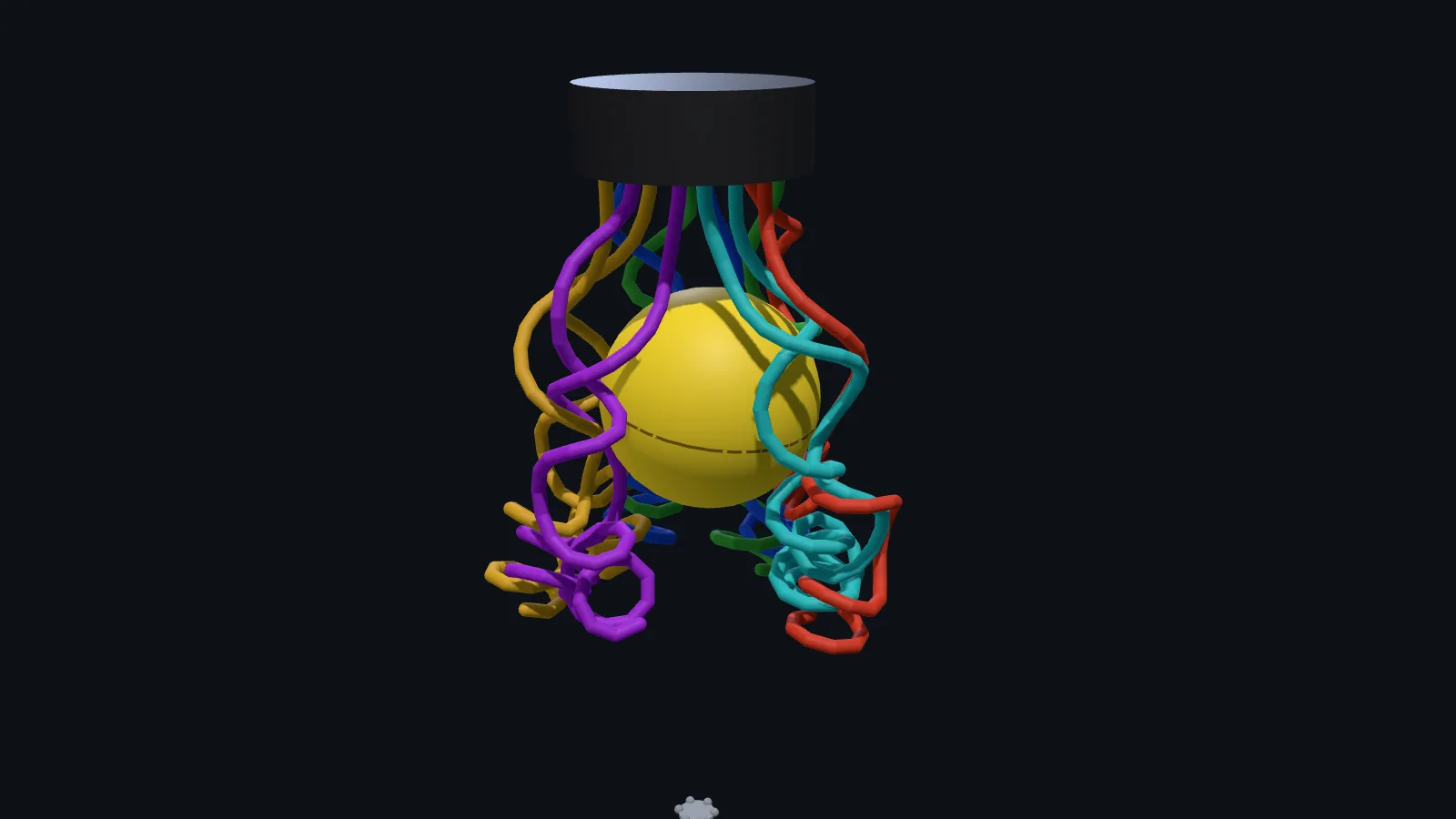
Twelve pneumatic filaments hang from a hub: the entanglement gripper of Becker et al. Each is simulated here, with the rod model of section 1, as a chain of 40 elastic links whose natural curvature rises with the pressure. Lowered around a 65 mm foam ball and pressurized, they curl and tangle, and the hub lifts.

The grasp is stochastic. With the curl directions drawn at random, 12 of 20 draws carried this ball; two of the runs here show a drop and a knock-off.

These replays are new simulations (October 2026), not figures from the paper.

The gripper itself, at real speed: lowered over an object, the filaments curl around it and around one another, and the arm lifts. Experiment by Kaitlyn Becker and colleagues in Robert Wood's group.
Paper
K. Becker, C. Teeple, N. Charles, Y. Jung, D. Baum, J. C. Weaver, L. Mahadevan, R. Wood. Active entanglement enables stochastic, topological grasping.PNAS 119, e2209819119 (2022)
Shown
5 runs · 12 filaments of 40 links, 300 mm · a 65 mm, 2.75 g ball
2.3

Entanglement as the objective

  • optimization
  • linking number
  • non-penetration

Fifteen rods of aspect ratio 30 start parallel with their centres on a ring. A minimiser then raises the total linking number between them, while a stiff repulsion pushes apart any pair that comes closer than one rod diameter. The run stops by the solver's own rule after 111,620 iterations, with Σ|Lk| up from 0 to 45.2 over the 105 pairs. The repulsion is a penalty, not a hard constraint, so the rods end up pressed 1–2% into each other.

In the paper, packings that maximize the average crossing number under non-penetration turn out to be self-caged: held together by repulsion and friction alone.

Paper
Y. Jung, L. Mahadevan. Emergent cohesion via self-caging in maximally entangled rod packings.Physical Review Letters, under revision · arXiv:2606.03952
Shown
One run to convergence, 111,620 iterations · 15 rods, length 6, radius 0.1

03 · Out of plane

Shape-morphing snake lattices

A lattice of sinusoidal filaments, joined where they cross, lies flat. Change the natural curvature of each span, so that some extend and others contract, and the closed loops can no longer stay in the plane: the sheet rises into a dome or a saddle.

In the paper, discrete elastic rod simulations predict the shapes that the printed lattices take when heated. The viewer is the problem that follows, and it is still open: choosing the change span by span so that a flat lattice deploys into a surface asked for in advance.

The experiment. Two printed lattices at real speed, each from above and from the side: one rises from flat into a dome, the other into a saddle. Scale bars 25 mm. Experiment by Mustafa Abdelrahman and Jackson Wilt.
3.1

From flat to a dome or a saddle

  • inverse design
  • Newton's method
  • ongoing work

Two ways to choose the change in curvature. Two levels: one value for the inner spans and the opposite for the outer ones, up to ±30%. Optimized: one value per span, fitted to a target surface. Drag the slider to apply the change gradually, starting from the exact flat lattice, and watch the height and the two principal curvatures of the surface respond.

Lattices of 5 × 5 and 7 × 7 crossings. The model has no contact, and a small transverse load, released at the end, picks the side the sheet buckles to.

Paper
M. K. Abdelrahman, J. K. Wilt, Y. Jung, R. Telles, G. K. Paink, N. M. Larson, J. Aizenberg, L. Mahadevan, J. A. Lewis. Rotational 3D printing of active–passive filaments and lattices with programmable shape morphing.PNAS 123, e2537250123 (2026)
Solved by
Newton's method for every equilibrium (sparse, damped, with a kick out of unstable states); Gauss–Newton for the fitted designs
Shown
Equilibria along a ramp of the curvature change, in 1% steps

04 · Reconstruction

Finding every rod in an X-ray scan

To compare a real packing with a simulated one, the tomogram first has to become a list of rods. The pipeline matches cylinders to voxels: find a rod, trace it, remove its voxels, look for the next. Fitting one cylinder is a small optimization problem: it can be done by direct search or, more simply, by a trimmed principal-component fit, which is a singular value decomposition.

4.1

A whole scan, rod by rod

  • X-ray tomography
  • segmentation

Every rod the cylinder-matching pipeline found in one image stack: 4,582 rods in 2000 × 2000 × 741 voxels, from 4,664 traces made in 722 s, then cut at kinks and joined into whole rods. Press Play to watch them appear in the order they were found. Colour them by direction or length, cut a slab through the pack, or click a rod to read its numbers.

Paper
Y. Jung, T. Plumb-Reyes, H.-Y. G. Lin, L. Mahadevan. Entanglement transition in random rod packings.PNAS 122, e2401868122 (2025) · first author
Shown
4,582 rods at their measured radius, straightened to within one voxel of the traced centreline
4.2

How one rod is found

  • optimization
  • trimmed PCA (SVD)
  • direct search

A 201³-voxel crop from the dense centre of a packing, 442,435 rod voxels, segmented by four versions of the pipeline. Play runs two of them on the same clock, at their measured speeds.

Further down the page, one cylinder fit is taken step by step. A trimmed principal-component fit and a direct search (fminsearch) start from the same deliberately poor guess, 1.5 voxels off centre and 12° tilted, and each tries to fill the cylinder with voxels.

Paper
Y. Jung, T. Plumb-Reyes, H.-Y. G. Lin, L. Mahadevan. Entanglement transition in random rod packings.PNAS 122, e2401868122 (2025) · first author
Shown
One 201³ crop · four pipeline versions · one cylinder fit, two methods

05 · PhD · Seoul National University · 2019

Soft matter and soft robotics

My doctoral work, with Ho-Young Kim, was on how liquids move through sponges and soil, and on hydrogel devices.

  • Sponge

    Poro-elasto-capillary wicking of cellulose sponges

    J. Ha, J. Kim, Y. Jung, G. Yun, D.-N. Kim, H.-Y. Kim

    Science Advances 4, eaao7051 (2018)

    Capillary rise of water in cellulose sponges whose pores change shape as they take up water.

  • Porous flow

    A design principle of root length distribution of plants

    Y. Jung, K. Park, K. H. Jensen, W. Kim, H.-Y. Kim

    Journal of the Royal Society Interface 16, 20190556 (2019) · first author

    If roots maximize water uptake for the metabolic cost of growing them, root length density should fall logarithmically with depth. Biological data and root-mimicking networks agree.

  • Hydrogels

    Ionic spiderwebs

    Y. Lee, W. J. Song, Y. Jung, H. Yoo, M.-Y. Kim, H.-Y. Kim, J.-Y. Sun

    Science Robotics 5, eaaz5405 (2020)

    Threads that emulate a spider's capturing strategies with electrostatics, using a single pair of threads.

  • Hydrogels

    Soft artificial electroreceptors for noncontact spatial perception

    W. J. Song*, Y. Lee*, Y. Jung*, Y.-W. Kang, J. Kim, J.-M. Park, Y.-L. Park, H.-Y. Kim, J.-Y. Sun

    Science Advances 7, eabg9203 (2021) · * equal contribution

    Soft electroreceptors, inspired by electroreception in rays, that locate objects without touching them.

  • Hydrogels

    Capillarity ion concentration polarization as spontaneous desalting mechanism

    S. Park, Y. Jung, S. Y. Son, I. Cho, Y. Cho, H. Lee, H.-Y. Kim, S. J. Kim

    Nature Communications 7, 11223 (2016)

    Capillarity alone, with no electrical power, drives ion-selective transport through a nanoporous material and desalts the liquid next to it by more than 90%.

06 · Miscellaneous

Smaller tools and studies

  • Control · MuJoCo

    Righting a gliding snake

    Receding-horizon control in MuJoCo's fluid model: a snake-shaped glider tumbles after launch, then rights itself and glides belly-down. Built on the rod model of section 1.

  • MuJoCo C API

    Low-Reynolds swimmer in MuJoCo

    A flagellated swimmer driven through a resistance matrix. It advances 0.0326 m per motor revolution regardless of viscosity, and a scallop-theorem test closes to 0.02%.

  • Paper

    Phase transitions in the rolling of irregular cylinders and spheres

    D. Qian, Y. Jung, L. Mahadevan

    PNAS 122, e2417161122 (2025)

    How an irregular cylinder or sphere rolls down an incline: its terminal speed goes through first- and second-order transitions, and rolling spheres trace closed orbits that period-double.

  • Paper

    Avian mud nest architecture by self-secreted saliva

    Y. Jung, S. Jung, S.-i. Lee, W. Kim, H.-Y. Kim

    PNAS 118, e2018509118 (2021) · first author

    How swallows and phoebes build strong nests out of incohesive mud granules, using their saliva as a paste.

07 · The thread

It has all been optimization

Sometimes I pose the problem. Sometimes nature already has, and the work is to find what was optimized. Two questions from my PhD, and then the same question asked of everything above.

How is a plant root optimized?

For water uptake, against the metabolic cost of growing roots. The optimum is a root length density that falls logarithmically with depth, and biological data agree.

Y. Jung, K. Park, K. H. Jensen, W. Kim, H.-Y. Kim. A design principle of root length distribution of plants. J. R. Soc. Interface 16, 20190556 (2019)

How are human lungs optimized?

Airways narrow by a ratio of 0.79 per branching where they only conduct gas, and by 0.94 in the acinar airways, where gas is exchanged. At that observed geometry the oxygen transfer rate per unit surface area is at its maximum.

K. Park, Y. Jung, T. Son, Y.-J. Cho, N. L. Jeon, W. Kim, H.-Y. Kim. Optimal diameter reduction ratio of acinar airways in human lungs. PLOS ONE 14, e0204191 (2019)

What is optimized in each piece of work
WorkWhat is chosenTo do whatHow
Whip crackThe shoulder's 0.25 s drivePut the tip on a target, fastgradient through the simulation
Periodic whipFeedback gains on the shoulderHold an unstable cracking orbitperiodic LQR
Cat flipA gait of one jointHalf a turn with no angular momentumoptimization of the gait
CobraA policy for 15 motorsRear the head and hold it upreinforcement learning (PPO)
Rod packingWhere every rod sits and pointsMaximal total linking, no overlapenergy minimization (FIRE)
Snake latticeA curvature change per spanDeploy from flat into a target surfaceGauss–Newton on the design · Newton's method for each equilibrium
X-ray scanA cylinder for every rodAccount for the rod voxelstrimmed PCA · direct search
Plant rootsRoot length density with depthMost water for the cost of growingtheory, data, model networks
Human lungsDiameter reduction per branchingMost oxygen per unit surfacetheory against anatomy